
What You Need To Know
- Review the SAFE ACT Legislation here (HR 1661/S.775)
- Review the Van Drew-Titus Amendment to Build America 250 Act (HR 8870)
- Review the Wild Horse & Burro Act of 2025 (HR 4356)
- NEWS
- Over 20,000 American domestic and wild horses are exported to Mexico and Canada for slaughter for consumption annually. Unfortunate equines enter the slaughter pipeline either through auction or round ups.
- Kill buyers bid on these horses at auction and they are transported to kill pens or feed lots where they receive little nourishment or medical care even though contagious diseases such as Strangles fester at slaughter holding facilities. From there they are either sold online through social media brokers or sent out of the country for slaughter.
- U.S. horse slaughter plants were closed in 2007 which created a dangerous loophole and vulnerable horses must now endure and much more arduous journey. Our immediate concern is the flow of live horses exported to Mexico and Canada for slaughter for human consumption, including to France, China, Russia, Japan and other nations.
- An investigation conducted by Animals’ Angels and Animal Wellness Action shows that there is no worse fate for a horse than being in the slaughter pipeline. Injured animals never get treatment, they slip on manure-and urine-soaked floors on transport trucks and fall and get trampled, they are subjected to temperatures of minus 30 Fahrenheit in unprotected holding pens outside of the Bouvry Ltd (Alberta) and Viande Richeleiu slaughter plants in Canada. The full investigative report is here. Allowing the pipeline to operate also provides cover for black market businesses like drug trafficking.
- There is no truth to horse slaughter being a needed outlet for “unwanted horses.” There’s been no uptick in abandonment or cruelty tracked by animal welfare groups over the last 30 years. This crucial fact pattern shows that the United States has other means of handling horses some may not want, whether through euthanasia, re-sale, adoption, or horse rescue operations. That assessment undercuts what was long the primary argument of the apologists of horse slaughter for human consumption and is simply unjustified.
- While last year's slaughter numbers were up, the decline of the North American horse slaughter trade has been progressing as international demand dwindles because of the understanding of the severely inhumane treatment of the horses in the pipeline and due to food safety concerns. Horses are often treated with substances unsafe for humans. Testing of the meat showed residues of drugs prohibited for human consumption. Most observers still consider this meat unsafe because of a lack of traceability in the “supply chain.”
- The horse slaughter industry is unregulated and provides no meaningful contribution to the U.S. economy. It is completely inhumane in its treatment and transport of horses and the world is taking note. There is global movement away from exploiting horses and other equines including an E.U. ban on the import of horse meat from the U.S. via Mexico due to toxicity and the inability to regulate safety, Canada’s House of Commons is considering ending the live transport of horses for slaughter, a major French retail chain announced it will no longer import horse meat from Canada or South America, Switzerland’s top retailer ends relationship with Canada’s Bouvry plant which is responsible for the slaughter of many American horses, the UK House of Commons passed a ban of the export of live horses for the purpose of slaughter, and Greece banned the slaughter of horses for meat, skins, and various other products. In the U.S., The American Veterinary Medical Association, the Thoroughbred racing industry and the Trotting industry now favors a ban on horse slaughter. The racing association, breeders, trainers, and all major animal welfare groups also support a ban on horse slaughter and the SAFE Act.
- Besides the obvious cruelty to animals, we have recently learned that the slaughter pipeline also gives cover to criminals involved in human, sex and drug trafficking. Related, the pipeline is responsible for spreading dangerous zoonotic and other infectious diseases that could be antibiotic resistant and very hard to treat. Most kill buyers are finding greater profits as horse traders, selling horses in the US but they are still using slaughter as a marketing tool and that’s atrocious. The slaughter pipeline must close, horsemen will take greater responsibility, American horses will be absorbed into the community, and there should be more transparency and better conditions by traders on behalf of the horses in their care. Slaughter numbers are up again this year but horses sent to slaughter represent .4% of all horses in the United States. There are homes in America for these .4% of the population.
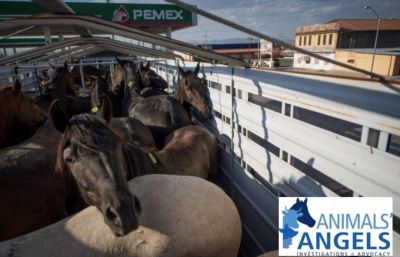
For on the ground reporting and investigative work, please visit our partner, Animals' Angels, whose tireless work continues to shine light in dark places. For the horses.